This project improves skills and economic opportunities for women and youth in Cox’s Bazar through pre-vocational and vocational training. Participants gain practical skills in computer operation, graphic design, digital marketing, and tailoring to increase employability, freelancing, and sustainable livelihoods.
The initiative provides market-relevant training for 400 women and youth across Cox’s Bazar Sadar, Ramu, Pekua, and Moheshkhali. Through courses in computer operation, digital marketing, graphic design, and tailoring, participants build digital skills and income-generating opportunities.
Project Completion Report
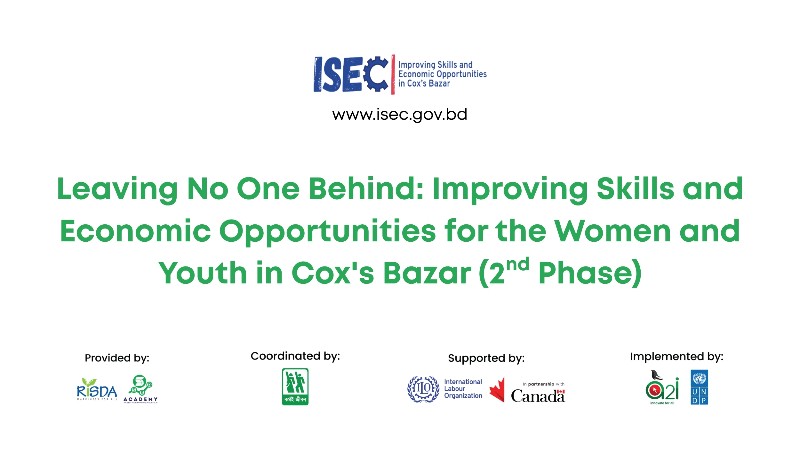
Leaving No One Behind: Improving Skills and Economic Opportunities for Women and Youth in Cox’s Bazar, Bangladesh (ISEC)
Project Background
The project “Leaving No One Behind: Improving Skills and Economic Opportunities for Women and Youth in Cox’s Bazar, Bangladesh (ISEC)” was designed to strengthen livelihood opportunities, skills development, and economic empowerment for vulnerable communities in Cox’s Bazar district.
The initiative focused on providing market-oriented vocational and pre-vocational training to youth and women, particularly those studying in madrasa institutions and individuals from underserved communities.
Through structured training programs and competency-based learning, the project aimed to equip participants with practical technical skills, digital literacy, and income-generating abilities to enhance their employment prospects and economic resilience.
Project Partnership and Support
The project was implemented through strong collaboration between international donors, development organizations, and local training institutions.
Coordinated By:
Department of Youth Development (DYD)
Funded by
Government of Global Affairs Canada
Government of Netherlands
Supported by
United Nations Development Programme (UNDP)
Food and Agriculture Organization (FAO)
Implemented by
BRAC
a2i (Aspire to Innovate)
International Labour Organization (ILO)
Training Provider
SSD Academy (Step-Up Skill Development Academy)
These partnerships ensured that the training programs followed international development standards and competency-based learning frameworks.
Project Location
The training activities were implemented across Cox’s Bazar district in Bangladesh, covering several key upazilas including:
Cox’s Bazar Sadar
Ramu
Pekua
Moheshkhali
These areas were selected due to their high need for skills development programs, youth employment opportunities, and women's economic empowerment initiatives.
Project Target Group
The project primarily targeted:
Youth from madrasa institutions
Young job seekers
Women interested in livelihood opportunities
Individuals seeking vocational skills training
A total of 320 + 80 learners (400 participants) benefited from the program through pre-vocational and vocational training courses.
Training Programs
The project delivered two main categories of training:
1. Pre-Vocational Training
Computer Operation and Graphic Design (CO&GD), Pre-Voc-Level-01
Tailoring and Dress Making (TDM), Pre-Voc-Level-01
2. Vocational Training
Digital Marketing for Freelancing (DMF), BNQF, Level- 03
Computer Operation (CO), BNQF, Level-02
Each course was designed to provide practical skills aligned with labor market demands and digital economy opportunities.
Pre-Vocational Training Implementation
The pre-vocational training program introduced madrasa learners to technical and creative skills, preparing them for future vocational training or employment opportunities.
Each course included:
72 total classes
5 hours per training session
Practical hands-on training
Competency assessments
Continuous monitoring and evaluation
Rashidia Azizul Uloom Madrasah Yeatimkhana & Hafzakhana (RAUMYH) – Ramu
This training center provided Computer Operation and Graphic Design training to madrasa students.
Training Details
Location: Chaillatali, South Mithachari, Ramu, Cox’s Bazar
Learners: 80 male participants
Training start date: 18 August 2025
Total classes planned: 72
Completed classes: 47
Class duration: 5 hours per session
By the time of reporting, 40 participants successfully achieved full competency, demonstrating strong skills in basic computer applications, graphic design tools, and digital creativity.
Ehyea-Ulumiddin Madrasha & Yatimkhana (EUMY) – Moheshkhali
This training program also focused on Computer Operation and Graphic Design.
Training Details
Location: Chaillatali, Kalamarchada, Moheshkhali, Cox’s Bazar
Total learners: 80 male students
Start date: 1 September 2025
Total classes: 72
Completed classes: 38
Session duration: 5 hours
Participants developed skills in Microsoft Office, graphic design fundamentals, and digital communication tools, preparing them for future opportunities in the digital economy and freelancing sector.
Mohammadia Arabia Hafezia Madrasha & Etimkhana (MAHME) – Ramu
This training program introduced madrasa learners to ICT skills and creative design tools.
Training Details
Location: Joarianala, Ramu, Cox’s Bazar
Learners: 80 male participants
Training start date: 14 September 2025
Planned classes: 72
Completed classes: 28
Duration: 5 hours per class
The program enhanced students’ technology awareness and digital literacy, which are essential skills in today’s job market.
Hazrat Ayesha Chiddika (R.) Girls Madrasah – Pekua
To strengthen women’s economic empowerment, a Tailoring and Dress Making training program was conducted exclusively for female learners.
Training Details
Location: D.C Road, Chowmahoni, Pekua, Cox’s Bazar
Total learners: 80 female participants
Start date: 14 September 2025
Planned classes: 72
Completed classes: 28
Class duration: 5 hours
Participants learned sewing techniques, garment design, measurement, cutting, and dressmaking skills, enabling them to start home-based tailoring businesses or employment in local garment sectors.
Vocational Training Implementation
In addition to pre-vocational training, the project provided advanced vocational skills training through professional training institutions.
Digital Marketing for Freelancing – SSD Academy, Cox’s Bazar Branch
This vocational course focused on developing digital entrepreneurship and freelancing skills.
Training Details
Location: Gorakghata Municipality, Cox’s Bazar
Total learners: 40 participants
Male: 27
Female: 13
Start date: 27 September 2025
Planned classes: 72
Completed classes: 13
Class duration: 5 hours
Competency achievement rate: 82%
Learners gained knowledge in:
Social media marketing
Search engine optimization (SEO)
Freelancing marketplace management
Online branding strategies
These skills open opportunities for online employment and global freelancing platforms.
Computer Operation (Level-2) – SSD Academy, Moheshkhali Branch
The second vocational course provided advanced computer operation training.
Training Details
Location: Kalur Dokan, Moheshkhali
Total learners: 40 participants
Male: 18
Female: 22
Training start date: 27 September 2025
Planned classes: 72
Completed classes: 13
Class duration: 5 hours
Competency achievement rate: 78%
Participants gained advanced skills in office applications, digital documentation, and workplace computer operations.
Project Achievements
The project achieved significant outcomes in skills development and youth empowerment.
Key Results
Total training centers: 6
Total participants: 400 learners
Male participants: 285
Female participants: 115
Training courses delivered: 4 skill areas
Training hours delivered per learner: 360 hours
Impact on Women and Youth
The project played a vital role in improving economic opportunities for women and youth in Cox’s Bazar.
Major impacts include:
Increased digital literacy among madrasa students
Improved employability and job readiness
Expanded freelancing opportunities
Enhanced women’s income-generating skills
Strengthened community awareness of skills development programs
Many participants reported improved confidence and motivation to pursue entrepreneurship, freelancing, or employment opportunities.
Sustainability and Future Opportunities
To ensure long-term sustainability, the project recommends:
Expanding training programs to additional rural communities
Providing advanced freelancing and digital marketing courses
Establishing career placement and mentorship programs
Supporting graduates with entrepreneurship and startup opportunities
These initiatives will help create sustainable livelihoods and economic resilience for communities in Cox’s Bazar.
Conclusion
The project “Leaving No One Behind: Improving Skills and Economic Opportunities for Women and Youth in Cox’s Bazar” successfully empowered hundreds of young people with practical vocational skills and digital competencies.
Through collaboration with international donors, development partners, and local institutions, the initiative has created a strong foundation for inclusive economic development, youth employment, and women’s empowerment in Bangladesh.